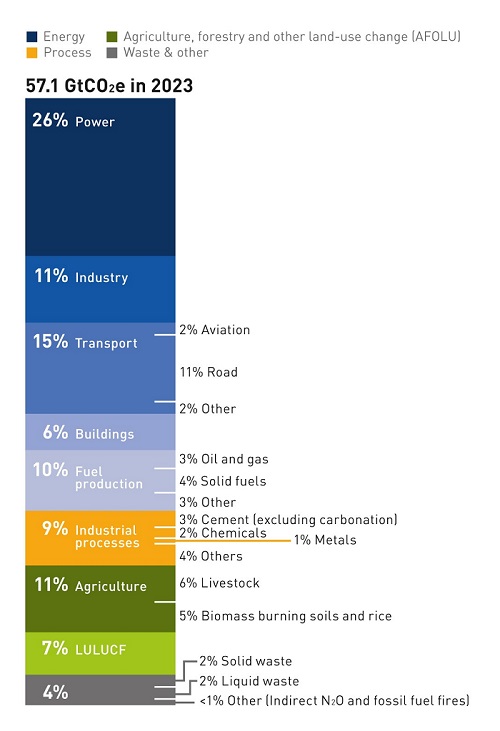
2023 share of aviation CO2 emissions compared with other parts of the economy. Source: UNEP Emissions Gap Report 2024
Aviation is an efficient means of long-distance transport, operating in many places more efficiently than the alternatives, such as road and even rail. For some travel, there is simply no practical alternative to flying — around 80% of aviation CO2 emissions are produced from flights greater than 1,500 kilometres.
Aviation is the preferred mode of transport for the majority of tourists: in 2023, 58% of international tourists travelled to their destinations by air, compared to 35.8% by road, 4.3% by water and 1.9% by rail.
Other greenhouse gases
CO2 is not the only greenhouse gas emitted by aircraft. Exhaust fumes from aircraft engines are made up of: 7% to 8% CO2 and water vapour, around 0.03% nitrogen oxides, unburned hydrocarbons, carbon monoxide and sulphur oxides, traces of the hydroxyl family and nitrogen compounds and small amounts of soot particles (although the industry has almost eliminated soot emissions over the past few decades). Between 91.5% and 92.5% of aircraft engine exhaust is normal atmospheric oxygen and nitrogen.
The water vapour trails (contrails) created by aircraft also have an impact, but research is inconclusive about whether these have a net warming or cooling effect on the earth. See Addressing contrails.
Overall impact
There are many references to aviation having a greater effect than other industries because of the height at which the emissions are released. The most significant greenhouse gas, CO2, does not have any additional impact due to difference in altitude, the impact is the same. However, other emissions such as nitrogen oxides and water vapour can have greater effect at higher altitudes. Scientists refer to this as a ‘multiplier’.
Recent research suggests that aviation CO2 emissions should be multiplied by 1.9 times to take account of the added impact of these other gases at altitude. However, it is important to realise that most other emitters also release non-CO2 gases and require a multiplier to determine their overall climate change impact (also known as radiative forcing). The rate for road transport, for example, is 1.5 times its CO2 emissions.
When these non-CO2 emissions and the multiplier are taken into account, the Intergovernmental Panel on Climate Change (IPCC) estimates aviation accounts for about 3% of total man-made climate impact. However, some experts say using a multiplier when calculating the emissions of individual flights is inappropriate, as it is a tool to describe longer-term impacts. Other sectors do not tend to have non-CO2 impacts added when calculating their carbon emissions.
Learn more about: