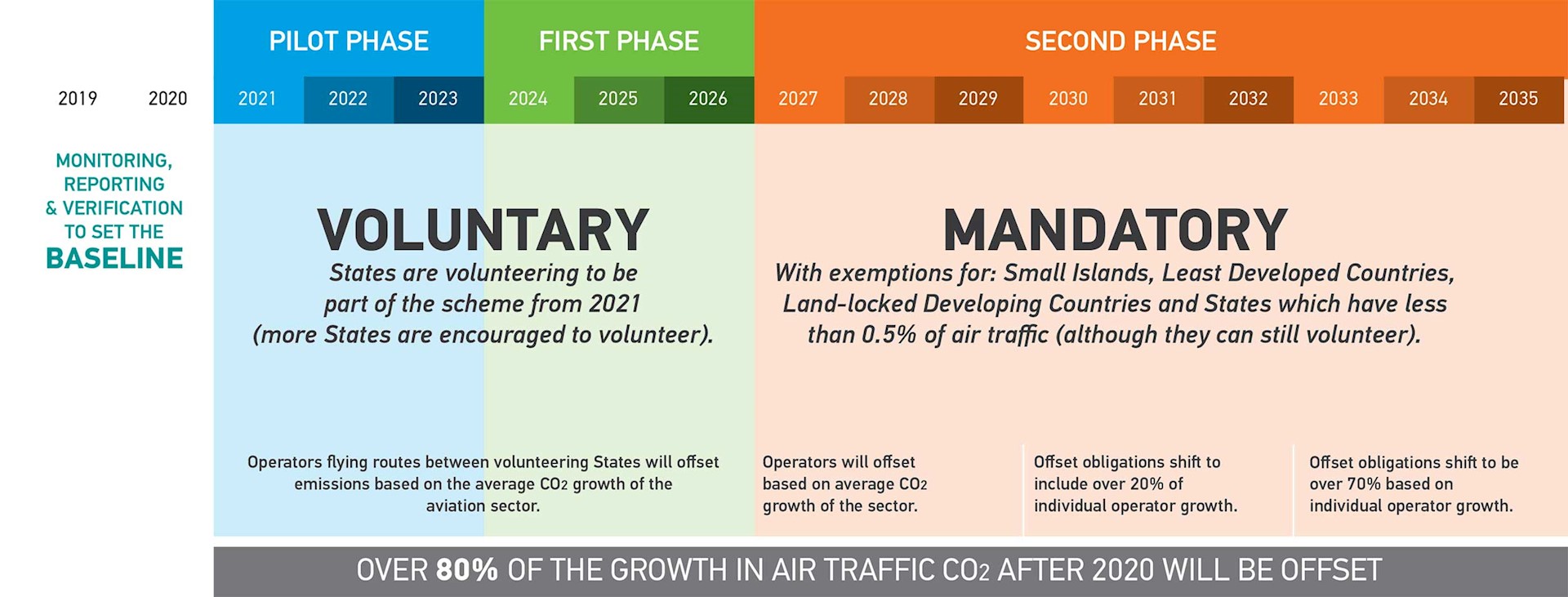

Aviation emissions from international flights have not been included in the international climate regime administered by the United Nations Framework Convention on Climate Change (UNFCCC), as these fall outside of the scope of nationally-determined climate action. Instead, these emissions are dealt with by the International Civil Aviation Organization (ICAO).
In October 2016, the member states of ICAO made the historic decision to adopt a global market-based measure for aviation emissions. This scheme, the Carbon Offsetting and Reduction Scheme for International Aviation – more commonly known as CORSIA – is the culmination of many years of work at ICAO, with the support of the industry.
As the name suggests, CORSIA is a global offsetting scheme, whereby airlines and other aircraft operators offset any growth in CO2 emissions above 85% of 2019 levels. This means that aviation’s net CO2 emissions are stabilised, while other emissions reduction measures, such as technology, sustainable aviation fuel, operations and infrastructure options, are pursued.
CORSIA only applies to international flights. Domestic emissions fall under the scope of the UNFCCC and are covered by the Paris Agreement.
The COVID-19 pandemic significantly impacted global air travel, leading to a substantial reduction in aviation emissions during 2020 and 2021. In June 2020, the ICAO Council therefore agreed that 2019 emissions would be used as the baseline against which reductions would be measured for the period of 2021-2023.
More recently, at its 41st Assembly in 2022, ICAO set 85% of 2019 emissions as CORSIA’s baseline from 2024 until the end of the scheme in 2035: a significantly more ambitious target than originally planned, which the industry supported.
Offsetting requirements under CORSIA began in 2021. Upon completion of each 3-year compliance period, operators are required to demonstrate that they have met their offsetting requirements by canceling the appropriate number of emissions units.
CORSIA is a global scheme which will result in greater levels of CO2 mitigation in international aviation than could be achieved through domestic policy measures. It is forecast that CORSIA will stabilise net CO2 emissions from international aviation at between 550 and 600 million tonnes of CO2 annually, between 2024 and 2035.
Between 1.3 and 1.7 billion tonnes of CO2 reductions are expected to be achieved during the same period. Depending on the traffic scenario, these reductions would represent between 15 and 21% of air transport's total emissions in that period.
IATA estimates that, without CORSIA, the CO2 footprint of international aviation would increase from slightly over 600 million tonnes of CO2 in 2019 to about 800 million tonnes of CO2 by 2035.
Read more about the industry's climate action goals here.
How does CORSIA work?
To secure a political agreement in ICAO and address the concerns of developing countries, the implementation of CORSIA has been divided into three phases – two initial, voluntary phases (2021-2023 and 2024 – 2026) and a mandatory phase from 2027.
During the initial phases, CORSIA only applies to international flights between states that have volunteered to take part, meaning that international flights to and from states that have not volunteered will be exempt.
During the mandatory stage, which begins in 2027, CORSIA will cover all international flights (including those travelling to or from states that had not volunteered for the early phases). There will, however, be some small exceptions:
- Least developed countries, small island developing states and landlocked developing countries (the United Nations directs which states are covered by these definitions). However, these states can volunteer if they wish (and some have, showing great climate and aviation leadership)
- States that have a very small share of international traffic
At the moment about 60% of total international aviation CO2 emissions are covered by the scheme. This is expected to increase to around 85% with the participation of large economies, like China, Brazil and India, in 2027. The industry is hopeful that more states will volunteer.