
Waypoint 2050

Environmental Climate solutions Technology Sustainable fuels Economic measures Operations Infrastructure

Waypoint 2050 draws on the collective expertise of global civil aviation industry experts to chart how the industry and its key stakeholders can fast-track joint efforts to support the world’s climate goals.

In 2022, the 41st Assembly of the International Civil Aviation Organization (ICAO) adopted a long-term goal for international aviation of net-zero carbon emissions by 2050 in support of the UNFCCC Paris Agreement's temperature target. 

Aviation’s net-zero pathway and roadmap of actions are essential to align the sector with global climate action and meet society's demand for more sustainable mobility. It is an important framework that encourages investment, supports jobs and creates the right conditions for aviation to continue to provide extensive economic and social benefits worldwide. 

The first and second Waypoint 2050 reports, published in 2020 and 2021, analysed how a long-term climate goal for aviation could be reached and explored various scenarios for the industry’s decarbonisation by 2050.

The third edition of Waypoint 2050, published in February 2026, assesses the industry’s progress towards achieving its net-zero goal and calls for support from key stakeholders to decarbonise air transport across four pillars: operational efficiency, technological development, sustainable aviation fuel (SAF) and market-based measures. 
Waypoint 2050 outlines where global efforts can have the most impact to ensure that aviation reaches net zero carbon by 2050.

What will enable net-zero aviation by 2050?

Aviation is a resilient industry. In 2025, air transport exceeded pre-Covid-19 traffic levels while continuing to make progress towards net zero carbon. Many of the required foundations are in place. Developments in modern fuel-efficient aircraft, propulsion systems and lightweight construction materials have enabled fuel and emissions savings, while operational improvements on the ground and in the air are also contributing to the industry’s common goal. 

SAF will play a crucial role in decarbonising air transport. It has the potential to reduce carbon lifecycle emissions by up to 80% compared to conventional jet fuel. However, while global SAF production output has approximately doubled each year since 2018, there has been slower-than-expected short-term progress in SAF deployment.

Urgent action is required to accelerate the scale-up and deployment of key measures to reduce carbon emissions. Net zero carbon by 2050 for aviation is an important and ambitious goal. It is very challenging but is still within reach if action is taken now. Each year of delay makes it harder and more costly for net zero to be achieved. Each missed opportunity for the right policy to be deployed pushes back progress. 

There is a five-year window to accelerate work to:

  • Scale up the production of SAF globally to match demand: SAF is the most important long-term lever for decarbonisation. 
  • Reaffirm support for and continue to implement ICAO’s CORSIA: A vital instrument for early action
  • Deploy fuel-efficient aircraft faster into the fleet: 
    To enable significant fuel savings 
  • Modernise air traffic management systems
  • Accelerate the development and scaling of carbon removals

Collective effort required

Waypoint 2050 tackles perhaps the most challenging part of air transport’s climate action: the energy transition and decarbonisation of the sector. Accelerating the scale-up and deployment of key measures to reduce carbon emissions is a collective effort. 

Not only does this require the industry and aviation institutions to work together, but for the energy sector to actively take the lead in aviation’s energy transition. Substantial investment will be needed from the finance sector in developing new technology and fuel, as well as  long-term supportive policies from government partners.

Various scenarios

There is no silver bullet nor single path to reach the 2050 goal. Many hundreds of scenarios to decarbonise air transport are possible when forecasting such a complex global system. Waypoint 2050 has chosen two illustrative options. This is to demonstrate that there is not just one pathway towards net zero carbon in 2050, but that all stakeholders will need to make choices as they accelerate progress.

The scenarios are built on a range of sub-scenarios covering traffic growth forecasts, technology developments, operations and infrastructure improvements, SAF and the role of market-based measures.

Full details can be found in the Waypoint 2050 report.

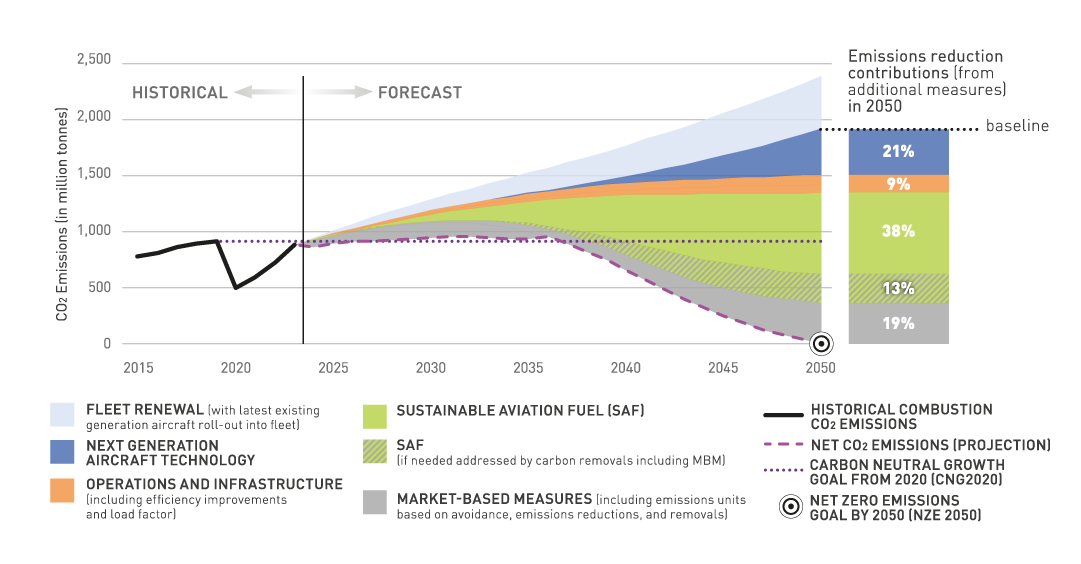
Scenario 1: focus on the deployment of sustainable aviation fuel

In this scenario, sustainable aviation fuel (SAF) is the primary decarbonisation lever. The scenario estimates the need for around 430-500 Mt of SAF. Technology improvements are moderately ambitious including some limited deployment of new aircraft configurations, along with advances in both traditional engines and the introduction of open rotor technologies.

There is no significant shift to electric or hybrid technologies, with the industry prioritising investment in SAF. Higher investments in operations and infrastructure result in additional improvements and CO2 reductions. Residual emissions will be addressed through carbon removals and market-based measures (MBMs). 

Aviation’s energy transition is not only about cutting emissions. It is about creating new jobs, diversifying energy supply and securing the sector’s future. Scaling up SAF production will drive investment, create new jobs, support energy security and economic prosperity, especially in developing economies.

Scenarios Dic2025 Scenario 1

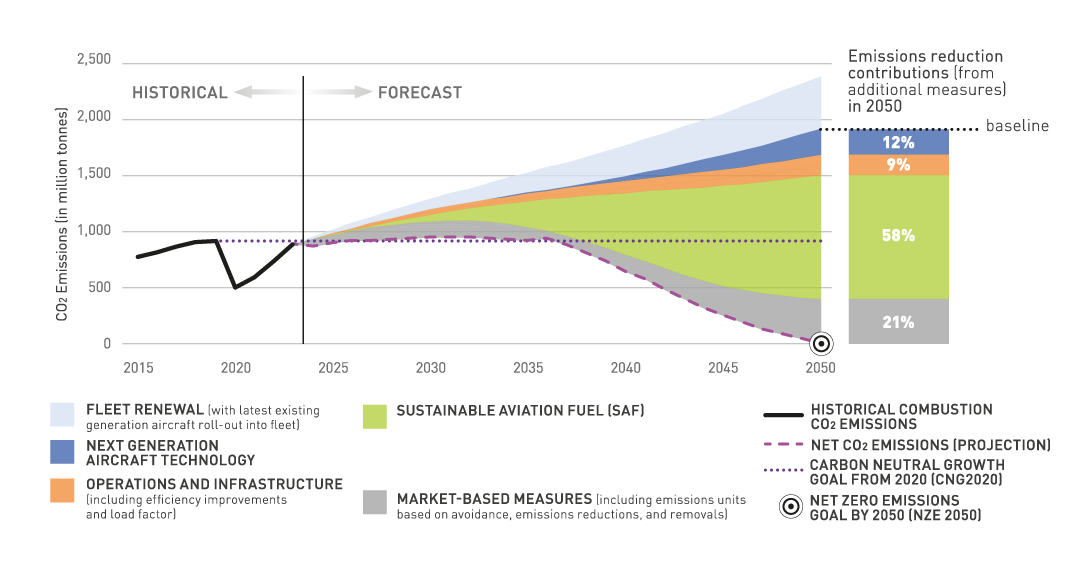
Scenario 2: technology at the centre

Scenario 2 is a technology and market-driven approach, including the very ambitious adoption of hydrogen, electric and hybrid-electric aircraft, starting in the next decade.

Hydrogen-powered aircraft enter service before 2045, serving the below 100-seat market. From around 2035, hybrid-electric powered aircraft start to enter the narrowbody market segment followed by a new generation of widebody aircraft also with hybrid-electric power architecture around 2040. Small electric aircraft on very short routes could be seen entering the market before 2030.

SAF and market-based measures would close the remaining gap, but the exact split will be determined over time, driven by market-related decisions on the cost of advanced SAF and carbon removals.

Despite a mid-level of traffic growth, higher investments in operations and infrastructure result in net improvements and CO2 reductions.

Scenarios Dic2025 Scenario 2